UK Safari Home Page
   A Website for Anyone Interested in the
   Wildlife and Countryside of Britain

Nature Photo

 Home | Animals + Nature | Nature Shop | Photography | Members Area | Latest News | Advertise | E-Cards


Free Newsletter

NewsletterSent to you
by e-mail

Simply enter your details and hit the send button
more info

Your name

e-mail address  


Search
 

First Visit?
Click Here


Explore More


Links
Advertise
Terms of Use
Contributors
About Us
Contact Us


Go back Go Back  |  Bookmark Add to Favourites  |  Print Page Print Page  | E-Mail Us Tell us what you think of this page

Moth  Oak Eggar

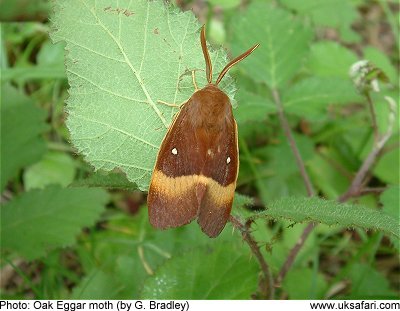
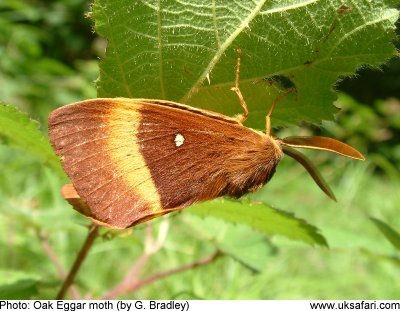
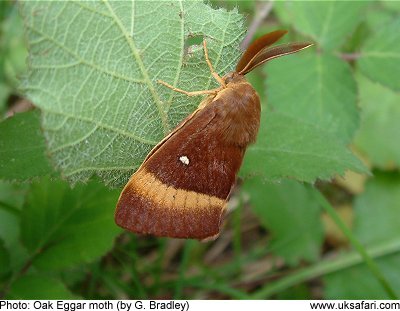
Oak Eggar - Photo © Copyright 2004 G. Bradley


Latin name:
Lasiocampa quercus

Size: Wingspan up to 90mm

Distribution: Common in most parts of England

Months seen: May to September

Habitat: Heathland, hedgerows and woodland edges.

Food: The larvae feed on heather, bramble, oak and hawthorn.

Special features: The male Oak eggar moth can sometimes be seen flying by day. They're particularly noticeable because of their large size. The females tend to fly at night, and are sometimes attracted to light.
Oak eggar moths have chestnut brown wings with a flared yellow line running through them, and a white dot on each forewing.

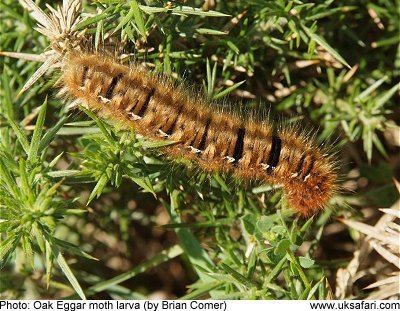
The caterpillars are covered in brown coloured hairs. Between each body segement is a black line. There are also small tufts of white fur along the sides on each segment.

Oak Eggar Larva - Photo © Copyright 2008 Craig Lewis


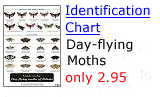
Click for more infoDay-flying Moth Identification Chart

Learn how to recognise 103 species of day-flying macro-moths, plus several night-flying species which can sometimes appear during the day
Our Price - £2.95


Track Down More Info

UK Safari Moth Section


 © 2006 G. Bradley. All Rights Reserved