

 Elephant Hawk-Moths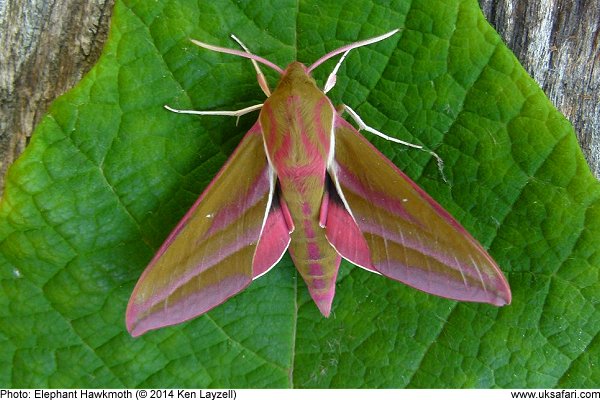

 Quick Facts
Scientific name: Deilephila elpenor
Size: Wingspan approximately 70mm
Distribution: Found throughout most of England, Wales and Ireland. In Scotland they are mainly found in the south and west
Months seen: May to July. The large caterpillars are seen from July to September
Life span: Adult moths live for up to 5 weeks
Habitat: Gardens, waste ground and woodland clearings
Food: Nectar. The caterpillars feed on bedstraws, willowherbs and in gardens they feed on fuchsias, and gooseberry
Special features: Large Elephant hawk-moths are one of the most brightly coloured moths found in the UK. Here at UK Safari we often receive email messages from people saying they've seen a "pink butterfly" which usually turns out to be an Elephant Hawkmoth.
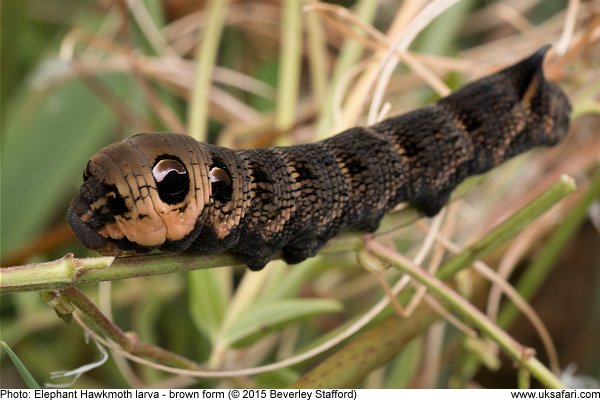
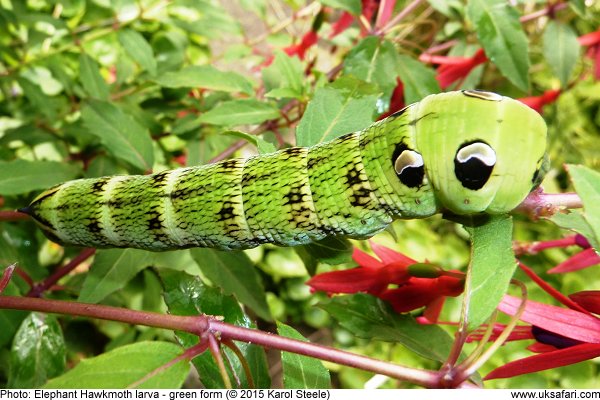
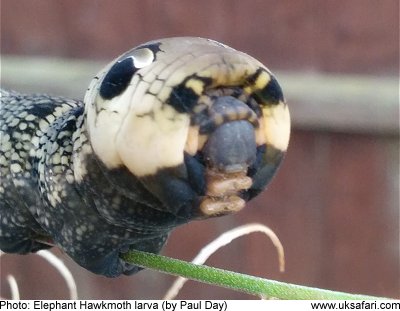
The "Elephant" part of the name comes from the caterpillars which have a trunk-like section just behind the head. It can be extended or retracted as a defensive tactic (see photos above). When it feels threatened it draws this trunk in towards its body. This shields the head from danger and has the added advantage of inflating its body, making the four eye markings look much larger.
The caterpillars can be green but are more frequently brown with a net like pattern along the body, as well as the four large 'eye' markings at the head end. The two colour forms may be a defence tactic. If a predator is looking for green caterpillars it may not see the brown ones and vice-versa.
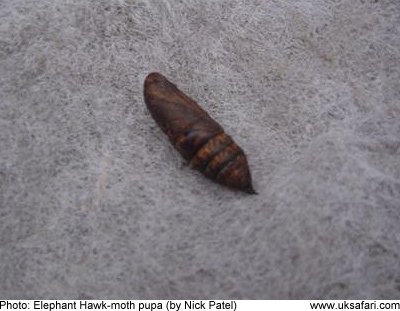
When fully grown the caterpillar moves down to the ground to pupate. It remains in this state until the following spring (May/June) when it emerges as an adult moth.
 Related Pages
- Elephant Hawk-moth Sightings
- Small Elephant Hawkmoth Fact File
- UK Safari Moth Section
- UK Safari Butterflies Section
- Free Newsletter



 Popular Pages
Amphibians, Bats, Badgers, Beetles, Birds, Birds of Prey, Bumble Bees, Butterflies, Caterpillars, Creepy-Crawlies, Deadly Spiders, Dolphins, Dragonflies, E-Postcards, False Widow Spiders, Free Newsletter, Frogs, Fungi, Garden Spiders, Glow-Worms, Grey Squirrels, Hedgehogs, House Spiders, Ladybirds, Mammals, Marine Mammals, Moths, Owls, Reptiles, Spiders, Toads, Trees, Wildlife Hospitals
Copyright © 2020 G. Bradley UK Safari. All rights reserved | About Us | Links | Contributors