

 Is This a Deadly Spider?
Identify It > Spiders Section > Is This a Deadly Spider? >
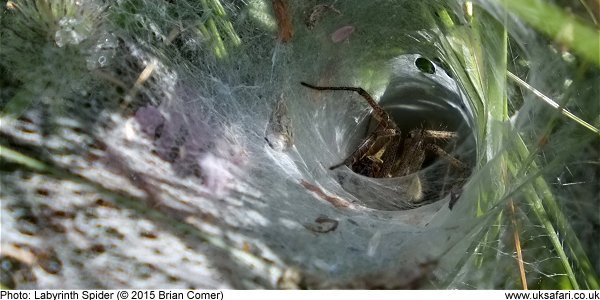
If we could charge a pound for every question we receive about "giant-deadly-poisonous-funnel-weaving-man-eating-black-widow-spiders" we could retire today.
If you've found one of these "giant-deadly-poisonous-funnel-weaving-man-eating-black-widow-spiders" then don't worry. Even though some spiders can, and occasionally do, bite, it's very unlikely the spiders around your house are venomous to you or your pets. Although spiders use venom to overpower their prey, there are only a few spiders which have fangs strong enough to pierce human skin. If there are venomous spiders in your area, you will probably hear about them from your friends and neighbours.
Ones to Avoid
Despite the fact that there are no particularly dangerous spiders in UK, they seem to strike fear into people more than any other creature. We wanted to find out if any of this fear was justified, so to get an expert opinion we contacted Ian Dawson from the British Arachnological Society and asked him if there are any spiders in the U.K. which people should be wary of. Here's what he told us...
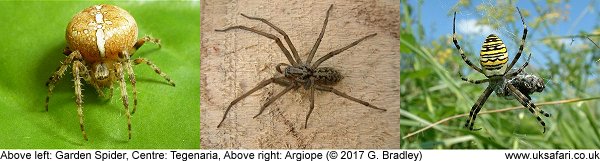
 Garden Spiders (Araneus diadematus) have been recorded biting occasionally causing inflammation and itching for a day or two, and it is probable that a few other large spiders such as Wasp Spiders have jaws which can pierce human skin - though I have never heard a convincing report of Argiope biting.
One interesting case is Tegenaria agrestis, a spider native to Europe (including southern Britain) which has been introduced to the U.S.A. where it is known as the "Hobo Spider" and has a bad reputation for giving nasty bites. To the best of my knowledge it has never been recorded biting in Europe, so the only plausible explanation I have read is that a different genotype has arisen over there.
The large hairy spiders which turn up in the bathtub are also members of the genus Tegenaria, several species of which occur commonly in houses, but none posing the slightest threat.
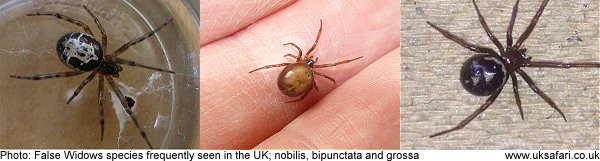
The only species which has a bad reputation is the False Widow which occurs in association with human habitation in many parts of England and Wales, and has been implicated in having a bite bad enough to need medical attention. However, it is certainly not life-threatening and the few bad bites may be more a case of someone reacting badly, just as some people are allergic to wasp stings. It can be very abundant where it occurs, and yet we never hear of it causing problems. Certainly none of our few spiders that have been recorded biting are at all aggressive, so any bites are accidental.
Exotics
Exotic spiders can arrive from other countries as stowaways on boats and aircraft, but this is rare, which explains why stories of this happening make it into the news. If it were a common occurrence it would be ignored by the media. In any case their chances of survival are slim. Most spiders live for just one year.
Black Widows
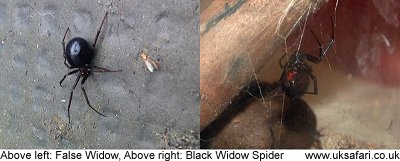
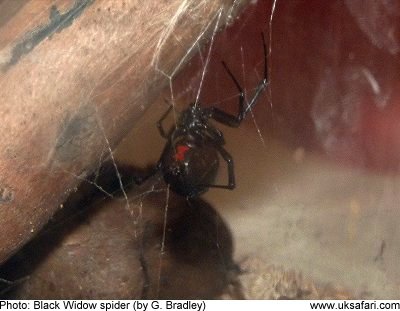
Black Widow Spiders (Latrodectus mactans) are about 12mm long. They are shiny and black, usually with a bright red hour glass shaped marking on their back end, although the colour of this mark can vary to orange, yellow or white. Black widows, and their relatives, can be found in America, Australia, Africa, New Zealand and the warmer parts of Southern Europe.

 Related Pages


 Popular Pages
Amphibians, Bats, Badgers, Beetles, Birds, Birds of Prey, Bumble Bees, Butterflies, Caterpillars, Creepy-Crawlies, Deadly Spiders, Dolphins, Dragonflies, E-Postcards, False Widow Spiders, Free Newsletter, Frogs, Fungi, Garden Spiders, Glow-Worms, Grey Squirrels, Hedgehogs, House Spiders, Ladybirds, Mammals, Marine Mammals, Moths, Owls, Reptiles, Spiders, Toads, Trees, Wildlife Hospitals
© Copyright 2017 G. Bradley - UK Safari | About Us | Links | Contributors