

 Glow-worms
Identify It > Creepy-crawlies Section > Beetles Section > Glow-worms >
Recent Sightings
2015 - 11 May - Paula McGuirk - Swadlincote, Leicestershire - 1 larva
2015 - 20 Jun - Karene Wainwright - Flimwell, Wadhurst, East Sussex - 3 females, 2 males
2015 - 21 Jun - Peter Thorn - Reading, West Berkshire - 1 female
2015 - 25 Jun - Carla Finch - Trehare, Calstock, Cornwall - 1 male
2015 - 07 Jul - Karene Wainwright - Flimwell, Wadhurst, East Sussex - 2 females, 1 male
2015 - 07 Jul - David Stone - Mottisfont, Romsey, Hampshire - 2 females
2015 - 10 Jul - Mike Starks - Dinnaton, Ivybridge, Devon - 1 female
2015 - 11 Jul - Diane Mellor - Knettishal Heath near Thetford, Norfolk - 1 female
2015 - 11 Jul - Amy Hall - Ketton Quarry, Lincolnshire - 7 females
2015 - 12 Jul - Madysin Lacourte - Windsor, Berkshire - 1 male
2015 - 23 Jul - Sally Stone - Wimborne, Dorset - 3 females
2015 - 02 Aug - Richard Bignall - Lewes, East Sussex - 10 females
2015 - 04 Aug - James Barnett - Alsager, Cheshire - 6 females
2015 - 06 Aug - Margaret Head - Cowfold, West Sussex - 10 females
2015 - 27 Aug - Fred Ellis - Eartham, nr Arundel, West Sussex - 1 larva
2015 - 30 Aug - Fen Marshall - Wotton under Edge, Gloucestershire - 4 females
2015 - 31 Dec - David Button - Brownstone, S. Devon - 1 female
2016 - 19 Apr - Lawrence Sampson - Blean Woods, Kent - 1 larva
2016 - 25 May - Dr. J Harry Baumer - Yealmpton, Plymouth, Devon - 2 larvae
2016 - 31 May - Rebecca Polain - Brede, East Sussex - 1 larva
2016 - 12 Jun - Eleanor Sweet - Corfe Castle, Dorset - 4 females
2016 - 16 Jun - Rebecca Polain - Brede, East Sussex - 1 larva
2016 - 20 Jun - Margaret Mayo - Leiston Common, Suffolk - 1 female
2016 - 21 Jun - Angela Thomas - Brading, Isle of Wight - 1 female
2016 - 26 Jun - Victoria Hemming - Porthcawl coastal path, South Wales - 50+ females
2016 - 27 Jun - George Bullivant - Zeals, Warminster, Wiltshire - 1 female
2016 - 27 Jun - Michael S Pearey - Tuckenhay, Totnes, Devon - 6 females, 2 males
2016 - 03 Jul - Luke Roberts - Newdigate, Surrey - 3 females
2016 - 04 Jul - Lisa Osment - Charminster, Dorchester - 1 female
2016 - 05 Jul - Adam Paul Durrant - Grateley, Andover, Hampshire - 2 females
2016 - 07 Jul - Daryl Fitzpatrick - St. Helens, Isle of Wight - 3 females
2016 - 08 Jul - Graham Moates - Harling, Norfolk - 2 females
2016 - 10 Jul - Heather Hills - Clanfield, Nr Petersfield, Hampshire - 30 females
2016 - 10 Jul - Adrian Mitchell - Trushem, South Devon - 6 females
2016 - 11 Jul - Wayne, Scott and Kelly - Culford, Suffolk - 3 females
2016 - 16 Jul - Louise Clair Collins - Ferndown, Dorset - 7 females
2016 - 17 Jul - Julian Rayner - Medway Gate, Strood, Kent - 3 females
2016 - 22 Jul - Ken Ferris - Cranham, Gloucestershire - 1 female
2016 - 24 Jul - William Mcdowell - Ballymena, Co Antrim - 1 larva
2016 - 27 Jul - Hugh Woolley - Heyshott, West Sussex - 1 female
2016 - 03 Aug - Dee Woods - Ashurst Campsite, New Forest, Hampshire - 4 females
2016 - 08 Aug - Andrew Jackson-Shaw - Portland, Dorset - 3 females
2016 - 02 Sep - Jill Dewar - Medmenham, Buckinghamshire - 6 larva/females
2017 - 30 Apr - Jason Burk - Salcey Forest, Northamptonshire - 2 larvae
2017 - 02 May - Jay Moon - Stanford Le Hope, Thurrock, Essex - 1 larva
2017 - 04 Jun - Simon White - Broadhaven Beach, Pembrokeshire - 1 larva
2017 - 11 Jun - Letishia Tirda - Effingham, Surrey - 1 larva
2017 - 21 Jun - Tania Russell - Kingsteignton, Devon - 1 female
2017 - 29 Jun - Colin Bell - Dulwich Heath, Suffolk - 20 females
2017 - 01 Jul - Michael S Pearey - Tuckenhay, Totnes, Devon - 6 females
2017 - 01 Jul - Tony Meakin - Bridport, Dorset - 2 larvae
2017 - 02 Jul - James Lamb - Ardleigh, near Colchester - 1 female
2017 - 06 Jul - Amy - Burgess Hill, West Sussex - 3 females
2017 - 07 Jul - Rob - Minstead, Lyndhurst, Hampshire - 1 female
2017 - 10 Jul - Sarah Rainer - Carisbrooke Castle, Isle of Wight - 50 females
2017 - 22 Jul - Marie Iley - Leigh-on-Sea, Essex - 1 female
2017 - 31 Jul - Rachel Lindon - Hayle, St. Ives, Cornwall - 1 female
2017 - 31 Jul - Danny Barrett-James - South Hill near Somerton, Somerset - 10+ females
2017 - 02 Aug - Heather Wright - Seend, Wiltshire - 2 females
2017 - 05 Aug - Holly Playle - Westhall Church, near Westhall, Suffolk - 2 females
2017 - 06 Aug - Toby Leggott - Haldon Forest, Devon - 1 larva
2017 - 07 Aug - Andy Shead - Wichling, Kent - 1 female
2017 - 10 Aug - Rebecca Stobie - Martin, Hampshire - 1 female
2017 - 15 Aug - Pete Angel - Holsworthy Woods, Devon - 1 larva
2018 - 08 May - Christopher Rawlinson - Rhossili Bay, Swansea - 1 larva
2018 - 11 Jun - David Ward - Netherton, nr. Newton Abbot, Devon - 1 female
2018 - 11 Jun - Marion Robinson - May Beck car park, North Yorks Moors National Park - 6 females
2018 - 13 Jun - Jayne Ashurst - near Axminster, Devon - 1 female
2018 - 16 Jun - Felix Whiston - Cardiff - 2 females
2018 - 19 Jun - Liam Bradley - Haven Holiday Park, Perran Sand, Perranporth - 3 females
2018 - 26 Jun - Jon Lewis - Ripple, nr Tewkesbury, Worcestershire - 7 females
2018 - 26 Jun - Mike Pearey - Tuckenhay area, S. Devon - 6 females
2018 - 28 Jun - Mike Pearey - Tuckenhay area, S. Devon - 8 females
2018 - 28 Jun - Michael Stickler - Beech Estate, Battle, Sussex - 1 female
2018 - 28 Jun - Nathan Benstead - Folkestone, Kent - 2 females
2018 - 01 Jul - Dan Davey - Bembridge, Isle of Wight - 5 females
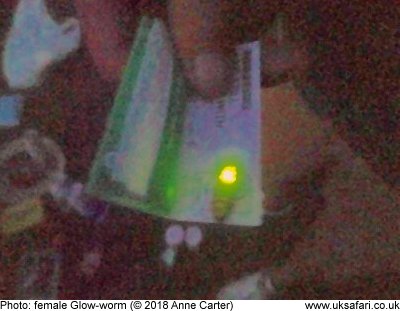
2018 - 02 Jul - Anne Carter - Lydford on Fosse, Somerset - 1 female (photo)
2018 - 11 Jul - Matthew Thomas Thorne and Elizabeth Bevan - Keynsham, Somerset - 2 females
2018 - 15 Jul - Michele Ryan - Barham, Suffolk - 1 female
2018 - 18 Jul - Edward Credland - South Pool, Devon - 4 females
2018 - 18 Jul - Michael Matson - Fairlight Wood, East Sussex - 1 female
2018 - 19 Jul - Grant Nicholas - Hythe, Kent - 3 females
2018 - 22 Jul - Jane Yates - canal near Claverton, Bath, Somerset - 17 females
2018 - 22 Jul - Sarah and How - path to Cogden beach, Dorset - 3 females
2018 - 23 Jul - Steve Stone - SW coast path Heybrook, Plymouth - 12 females
2018 - 26 Jul - Jackie Redman - Reigate, Surrey - 1 female
2018 - 27 Jul - Jon Lewis - Bow Lane, Ripple, Tewkesbury, Gloucestershire - 10 females
2018 - 30 Aug - Steven Bone - Chale, Isle of Wight - 2 females
2019 - 30 Jun - Tim D Teasdale - Norbert Park, Bookham, Surrey - 1 female
2019 - 30 Jun - Miles Leigh - Potton Woods, near Potton, Bedfordshire - 36 females, 12 males
2019 - 02 Jul - Ringmer East Sussex - Matt Atwood - 2 females
2019 - 20 Jul - Claire Dove - Hapton, near Norwich, Norfolk - 1 female
2019 - 21 Jul - Benjamin James Martin - Saunderton, High Wycombe, Bucks - 2 females
2019 - 21 Jul - Dover, Kent - Susannah Mannerings - 3 females
2020 - 22 May - Henley-on-Thames - Bertie Chapman - 1 larva
2020 - 30 May - Bewl Water, Flimwell, East Sussex - Helen Hazelwood - 1 female
2020 - 01 Jun - Llanfihangel Nant Bran, Near Brecon, Powys - Moira Stroud - 1 female
2020 - 07 Jun - Callington, Cornwall - Melissa Knight - 1 female
2020 - 08 Jun - nr. Chichester, Sussex - Max Keegan - 1 female
2020 - 26 Jun - Chaffcombe Somerset - Sally Sewell - 3 females
2020 - 06 Jul - Branscombe, Devon - Gary Worden - 8 females
2020 - 09 Jul - Shadoxhurst Ashford Kent - Glyn Purnell - 15 females
2020 - 11 Jul - Bartley, New Forest - Laura Katon - 1 Female
2020 - 20 Jul - The Warren, Folkestone, Kent - Kelly Hamilton - 3 females
2021 - 25 Jul - West of Blandford, Dorset - Andrew Tredrea - 2 larvae
2022 - 23 Jun - Winchester, Hampshire - Holly Wright - 24 females
2022 - 27 Jun - Garden in North Downs near West Kingsdown - Charlie Bergin - 2 females
2022 - 23 Jul - Treveague Farm footpath, near Gorran, Cornwall - Ellisha Nicholas - 1 female
2023 - 15 Jun - Midhurst, West Sussex - Spencer Lock - 3 females

 Quick Facts
Scientific name: Lampyris noctiluca
Size: Up to 15mm
Distribution: Found in parts of England (especially the south), lowland Scotland and Wales. No sightings received from N. Ireland
Months seen: Active from May to late August. They are most noticeable at night in June and July when the females light up to attract the males
Habitat: Meadows, parks, gardens and orchards on low growing vegetation. During the day they can be found under stones and logs
Food: The larvae feed on small snails and slugs. The adults rarely feed at all
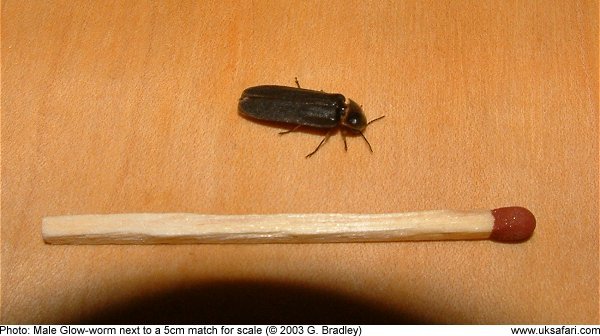
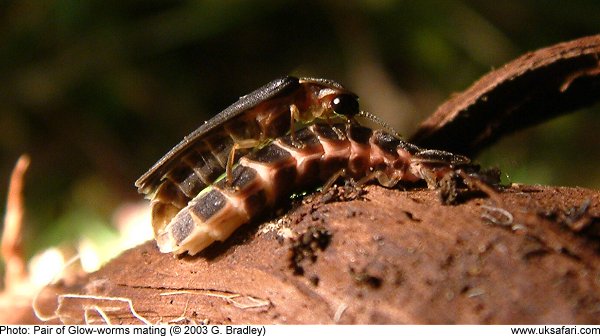
Special features: Glow-worms are not really worms at all. In fact they're beetles. This is most obvious when you see the male. The male is about 12mm long, and is a light brown colour. He's equipped with large, light-sensitive eyes which he uses for scanning for glowing females. Males have a weak fluttering flight, similar to moths.
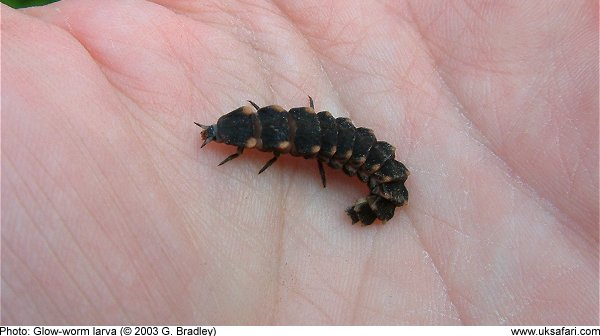
The larvae look like a cross between a caterpillar and a millipede. They're about 25mm long and have soft, rubbery bodies. The tail is equipped with a series of white bristles which they use to remove slime from their body after eating snails.
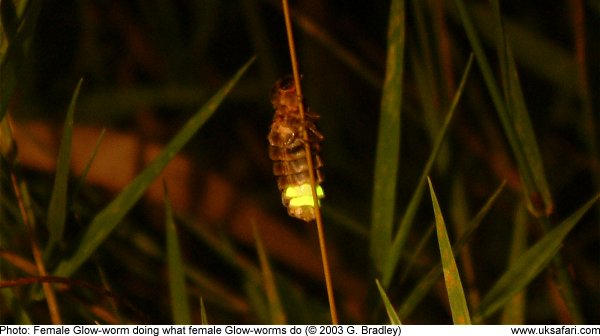
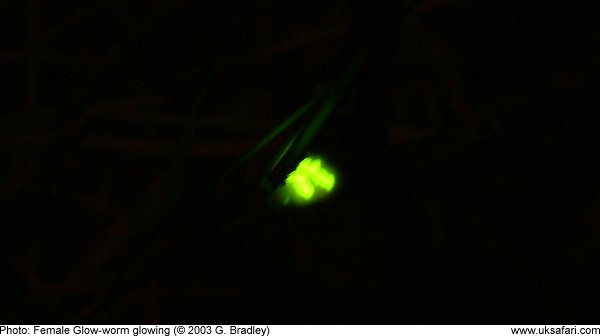
The female is the one noticed by most people since she produces a green light from her bottom. It's about as bright as an LED, like those on electronic gadgets. It is a cold light, so no energy is wasted in heat production. The light is created by a substance in the abdomen called luciferin, which when mixed with oxygen, breaks down creating the light.
Only the last few segments of the females abdomen emits light. She has complete control over the light emission, and is able to switch it on and off at will.
The larvae also emit light, but from a smaller patch, and even the eggs of the glow-worm, which are laid in clusters of up to 100, can emit light.
The adult glow-worms only survive for a few weeks, and in that time need to mate and lay eggs to ensure the survival of the next generation. All this depends on the low-flying male spotting the glowing female and mating successfully.
Street lighting and security lighting seems to have a detrimental effect on glow-worm reproduction. In areas where there is artificial lighting, males are attracted to this, and miss the females altogether. For this reason, glow-worm populations seem to survive better in areas with less 'light pollution'.
The best time to look for glow-worms is after 10pm when it's dark.
If you see any glow-worms please fill in the Glow-worm Sighting Form
 Related Pages
- Glow-worm Sighting Form
- UK Safari Glow-Worm Section
- UK Safari Beetles Section
- UK Safari Creepy-crawlies Section
- Free Newsletter



 Popular Pages
Amphibians, Bats, Badgers, Beetles, Birds, Birds of Prey, Bumble Bees, Butterflies, Caterpillars, Creepy-Crawlies, Deadly Spiders, Dolphins, Dragonflies, E-Postcards, False Widow Spiders, Free Newsletter, Frogs, Fungi, Garden Spiders, Glow-Worms, Grey Squirrels, Hedgehogs, House Spiders, Ladybirds, Mammals, Marine Mammals, Moths, Owls, Reptiles, Spiders, Toads, Trees, Wildlife Hospitals
Copyright © 2020 G. Bradley UK Safari. All rights reserved | About Us | Links | Contributors