

 Moles
Moles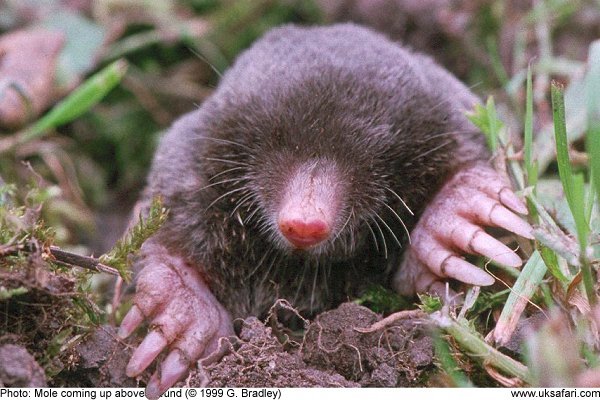

 Quick Facts
Scientific name: Talpa europaea
Size: Length around 15cm, weight approx. 100g to 150g
Distribution: Found in most of lowland Britain, but absent from Northern Ireland
Months seen: All year round
Life span: Up to 4 years
Habitat: Below ground in woodlands, fields, meadows and gardens
Food: Earthworms. Moles will only eat enough worms to satisfy their appetite. Surplus worms are prevented from escaping by biting off their heads and then storing in a special part of the tunnel, known as the 'moles larder'
Special features: Despite spending so much time in soil, moles manage to keep remarkably clean. This is because their fur is waterproof. In addition the mole's short fur can lay in any direction, so the mole can move forwards or backwards in a tunnel, without jamming its hair in the tunnel walls.
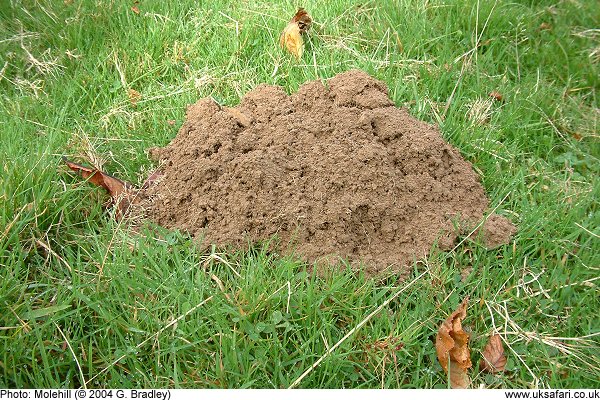
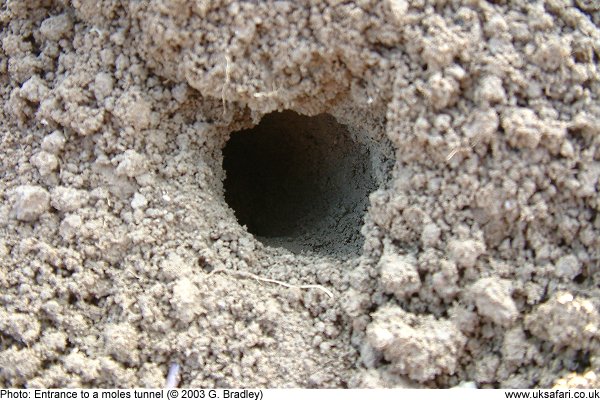
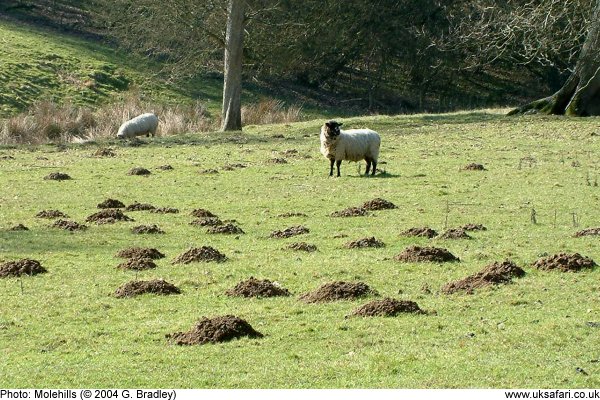
Moles are very active animals, working both day and night, and only stopping for short periods of rest. You can always tell where moles are tunneling, because every few metres they rise to the surface with a heap of freshly excavated soil known as a molehill). This can make them unpopular with gardeners and green keepers.
If you are bothered by moles there are humane mole traps which can be purchased very cheaply online.
Moles can move around 6 kilos of soil every 20 minutes. That's equivalent to a human weighing around 70 kilos moving approximately 4 tons of soil in 20 minutes!
Moles have 44 teeth, more than any other mammal in the UK. Being fiercely territorial, moles use their canine teeth to fight with other moles which invade their space. Because they spend most of their life underground in total darkness, it is believed they have poor eyesight.
Moles can do a complete u-turn anywhere in their network of underground tunnels. If you can imagine yourself in total darkness, in a long tunnel, the same diameter as the width of your shoulders, having to turn around and go back the way you came this will give you some idea of the physical skill involved.
In the late 1800's moleskin clothing was the height of fashion in Britain, and there were professional mole catchers, known as "Wanters", whose sole job was to kill and skin huge numbers of moles. By 1905 over one million skins a year were being sold in London, and twelve million a year were being sent to the United States!

 Related Pages
- Moles - A Pain in the Grass! (mole factsheet)
- UK Safari Mammals section
- Identify other wildlife
- Free Newsletter



 Popular Pages
Amphibians, Bats, Badgers, Beetles, Birds, Birds of Prey, Bumble Bees, Butterflies, Caterpillars, Creepy-Crawlies, Deadly Spiders, Dolphins, Dragonflies, E-Postcards, False Widow Spiders, Free Newsletter, Frogs, Fungi, Garden Spiders, Glow-Worms, Grey Squirrels, Hedgehogs, House Spiders, Ladybirds, Mammals, Marine Mammals, Moths, Owls, Reptiles, Spiders, Toads, Trees, Wildlife Hospitals
© Copyright 2017 G. Bradley - UK Safari | About Us | Links | Contributors