

 Rose Chafers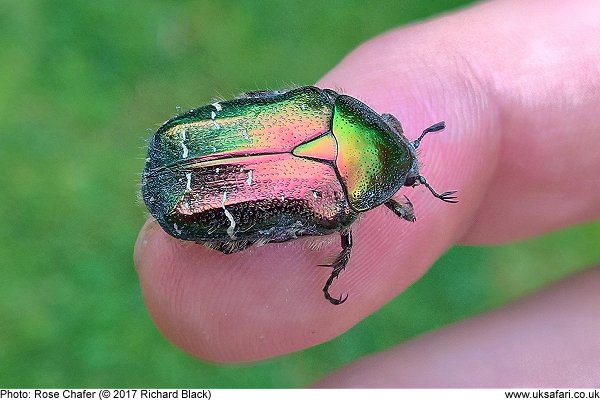

 Quick Facts
Scientific name: Cetonia aurata
Size: Approx 20mm long
Distribution: Found throughout the UK
Months seen: May to October
Life Span: 2 years as a larva, then 6 - 12 months as an adult beetle
Habitat: Meadows, parks and gardens. The larvae live and feed inside rotting timber and compost
Food: The larvae eat rotting vegetation and the adults eat pollen, nectar and petals
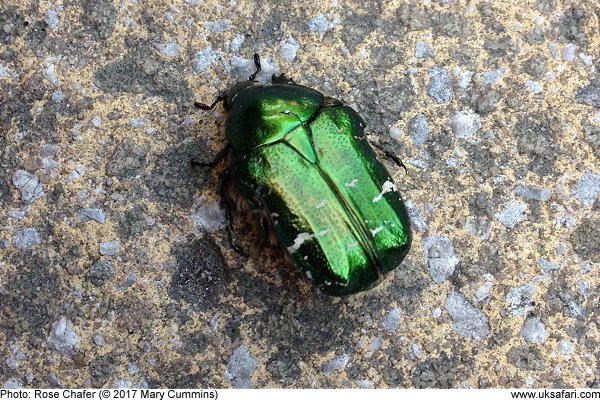
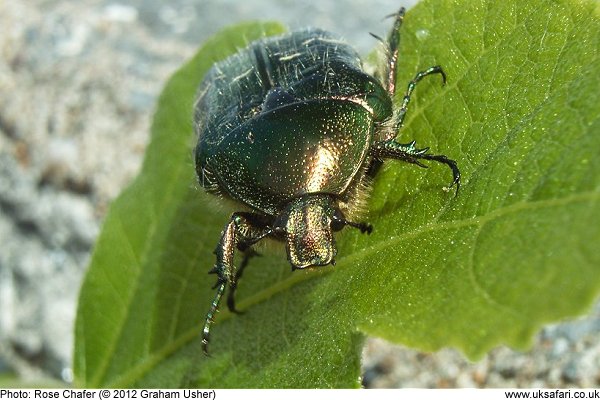
Special features: Rose Chafers are one of our larger and more attractive beetles. The upper surfaces are an iridescent emerald green and bronze colour. The underside is a bronze colour. There are ragged white marks running widthways across the wing casings which look like fine cracks. Rose Chafers are surprisingly furry. Even the wing casings which look very smooth and shiny are covered in tiny hairs.
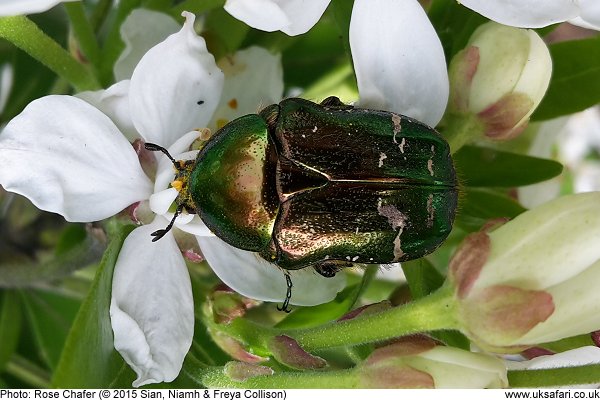
Rose Chafers are usually seen in on warm sunny days feeding on pollen and nectar. Their favoured plant, as their name suggests, is the rose.
The Rose Chafer is sometimes confused with the much rarer Noble chafer, a species normally associated with orchards. One simple way to tell the difference is to look at the scutellum (the small triangular area between the wing cases). On the Noble Chafer it's shaped like an equilateral triangle but on the Rose Chafer it's shaped like an isosceles triangle.
 Related Pages
- Rose Chafer Sightings
- UK Safari Beetles Section
- UK Safari Invertebrates Section
- Identify other wildlife
- Free Newsletter



 Popular Pages
Amphibians, Bats, Badgers, Beetles, Birds, Birds of Prey, Bumble Bees, Butterflies, Caterpillars, Creepy-Crawlies, Deadly Spiders, Dolphins, Dragonflies, E-Postcards, False Widow Spiders, Free Newsletter, Frogs, Fungi, Garden Spiders, Glow-Worms, Grey Squirrels, Hedgehogs, House Spiders, Ladybirds, Mammals, Marine Mammals, Moths, Owls, Reptiles, Spiders, Toads, Trees, Wildlife Hospitals
© Copyright 2018 G. Bradley - UK Safari | About Us | Links | Contributors